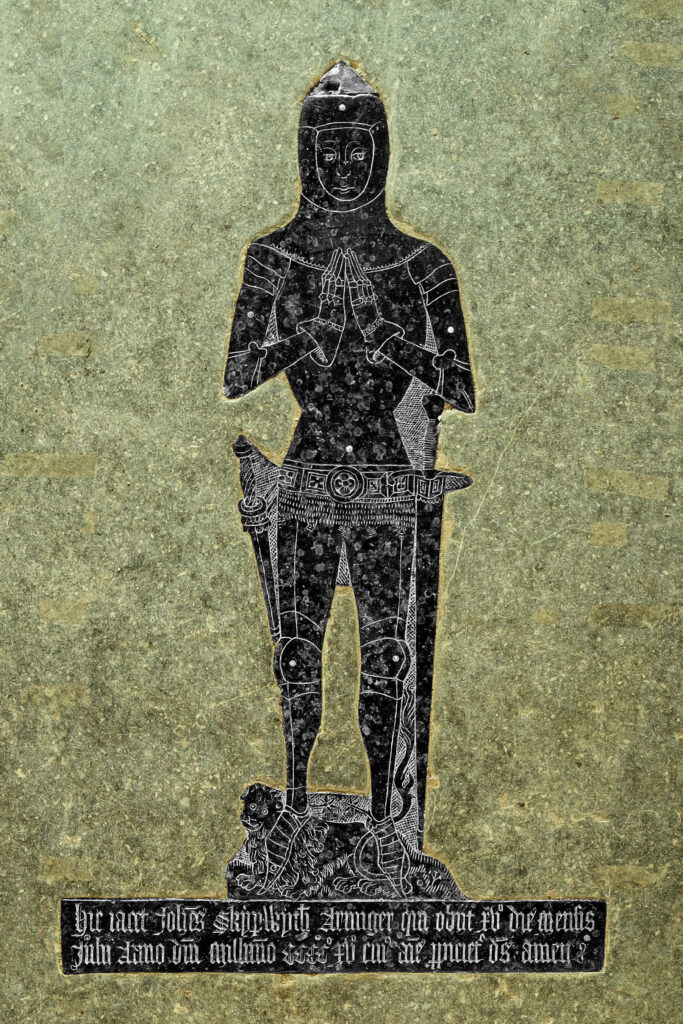
Buried in Covenham Church..
The house of Skipwith was an ancient and influential one, deriving its name from the Yorkshire village which was its home for centuries. Over the years, successive generations of the family extended their territorial influence, first by obtaining the manor of Menethorpe in the same county, and then by building up impressive holdings to the south in Lincolnshire. The manors of Ormsby, Laceby, Bigby and Thorpe, together with substantial appurtenances were systematically acquired through a policy of advantageous marriages. Sir William Skipwith, the royal judge, was in fact the fifth of his line to marry a Lincolnshire heiress. His wife, Alice Hiltoft, not only brought him the manors of North and South Hiltoft and Ingoldmells, but also the property which her mother, Alice le Muer, had inherited in Calthorp, Covenham and Uphall, together with extensive farmland in the surrounding countryside. These estates alone were worth over £200 p.a. in 1366; and Sir William thus became one of the richest landowners in the area. He was, moreover, able to consolidate his possessions through purchase, using the profits of his flourishing legal practice to buy land in and around Ormsby. So successful was he as a lawyer, that by 1362 he was serving as both a j.c.p. and a baron of the Exchequer, although three years later he was dismissed for alleged extortion and malpractice. After a period of disgrace, Skipwith again returned to favour, recovering his position on the English bench after a period as c.j.KB in Ireland. By pleading illness, he shrewdly managed to avoid attending upon Richard II at Nottingham in August 1387, and was consequently spared the fate of his colleagues, whose pronouncements on the royal prerogative at that time led to their collective impeachment before the Merciless Parliament of 1388. Indeed, he and his two eldest sons, William and John, the subject of this biography, were prominent among the Lincolnshire gentry who took oaths in March 1388 in support of the Lords Appellant.
Sir William had at least five sons and two daughters. Alice married Robert, 4th Lord Willoughby of Eresby, while her younger sister became the wife of Sir Henry Vavasour of Cockrington, a leading member of the Yorkshire gentry. The judge was no less anxious to make adequate provision for his younger sons, and a marriage was arranged between John Skipwith and Alice, the daughter of Sir Frederick Tilney, one of the richest men then living in Boston. The Tilneys exercised considerable influence in Lincolnshire, and for many years John maintained a close relationship with Sir Frederick’s younger brother, Sir Philip. His connection with the family probably accounts for his appointment in 1407 as controller of customs and subsidies in Boston—a post which his father-in-law had occupied in the previous century. He appears, moreover, to have benefited from an unusually generous settlement of property, for, although part of the Skipwith estates were entailed upon his elder brother and an income of 40 marks p.a. had been settled upon his mother from the manor of Ormsby, some land was given to him during the lifetime of his father and more came into his hands immediately on the latter’s death. As early as 1370 and again in 1372, Justice Skipwith made over to him a reversionary interest in the manors of Menethorpe (now Manthorpe?) and Skipwith should his brother’s issue die out, and he subsequently acquired a similar title to holdings in and around Bigby. A substantial proportion of the judge’s Lincolnshire property was meanwhile granted to him outright: in the spring of 1387, for example, he obtained a release of holdings in Cavenham and Little Grimsby, and from this date onwards he also presented to Asterby church. The manors of Ormsby and Ingoldmells together with land in Laceby were probably left to him by the judge, who died shortly before 1398. It was then, in his capacity as lord of the manor, that he chose a successor to his recently deceased brother, Stephen, the former rector of Ingoldmells. Certainly by October 1398 he and his wife were living at Calthorpe, where they were permitted by licence of the bishop of Lincoln to celebrate mass at a private chapel.
Not only did John Skipwith escape the financial problems which usually befell a younger son; he was also an ambitious and able man who soon overshadowed his elder brother and came to occupy a dominant position in Lincolnshire society. From 1384 onwards, when he and William became trustees of the manor of Manby for Sir John Roos, he was active as a feoffee-to-uses, most notably in 1391 for his wife’s uncle, Sir Philip Tilney.
King Richard’s readiness to accept him as tenant followed upon the award of two royal pardons which he sued out in February 1398. His earlier, albeit passing, connexion with the Lords Appellant may have caused Skipwith some concern at this time, but he is far more likely to have sought legal protection from the consequences of his misdeeds while sheriff of Lincolnshire. During his term of office he and his henchmen appear to have inflicted a virtual reign of terror upon the county, and as a result of six separate petitions submitted to the chancellor by his victims he was summoned to appear before the justices of assize at Lincoln in August 1397 to face charges of robbery with violence, blackmail, extortion, false imprisonment and intimidation. All these allegations were found to be true, although the court’s verdict had little effect upon his career, and by November 1398 he was again serving as a royal commissioner. This was a turbulent period in Skipwith’s life, for in May 1397 he was bound over in securities of £100 to keep the peace.
Somewhat surprisingly, in view of his social and financial position, which effectively placed him above the law, Skipwith did not enter Parliament until 1406. The session had just started when Philip Repingdon, bishop of Lincoln, renewed the permit which enabled Skipwith to hear mass in his own home;
His prospects had by then improved considerably, since the death of all his elder brother’s male heirs left him next in line to his childless niece, Elizabeth.
We do not know if he lived to enjoy his inheritance, but his younger son, Patrick, was certainly in possession of Bigby by 1428. Skipwith’s last years were clouded by the deaths of his sister, Margaret Vavasour, and her husband, both of whom (in 1413 and 1414 respectively) made him and his aged mother, Alice, beneficiaries of their wills. The MP was himself then involved in a protracted dispute over the implementation of the will of Thomas Missenden, who, much earlier, in 1402, had named him among his executors. The quarrel had serious consequences, in so far that it caused a rift between him and his friend, Sir Thomas Hawley, whose daughter and heir had by then married Patrick Skipwith. The two parties did, however, agree to submit to arbitration, and in July 1414 they offered mutual securities in £200 to abide by the ensuing award. Even so, it was not until November 1421 that Skipwith’s widow, Alice, and Patrick were finally discharged from these obligations.
John Skipwith died in 1415, and was buried at the parish church of Covenham.